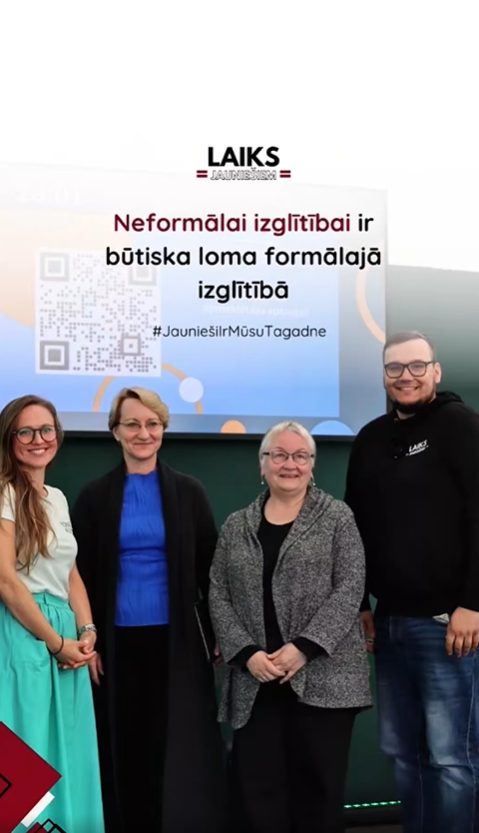
We are convinced that there is a need for more targeted integration of non-formal education approaches in formal education, enabling non-governmental organisations, youth centres, youth workers and other professionals to engage in the educational process. This would allow students to acquire more diverse skills and knowledge in life, contributing to their personal and social development.
Gints Jankovskis, Head of the Society for Youth, in a joint discussion with the Minister of Education and Science Dace Melbārde, Head of the Education, Culture and Sports Committee of the Riga City Council Laima Geikina, Riga Technical University Development and Financial Prorector Artūrs Zepu and Dana Narvaišs, stressed the need to expand the role of informal education in the Latvian education system. Although this process has already started, it has not yet reached the required scale.
We believe that school should not be just a place of transfer of academic knowledge - it should be an environment where the student's personality, living skills and participatory competences develop. A teacher cannot expect to have full comprehensive competence in questions of merit, participation and social skills. The sector's professionals outside school can contribute significantly here, thus diversifying the content and methodology of the training.
Each young person has a different background of knowledge and a more convenient individual learning approach. More flexible and up-to-date methods, including non-formal learning solutions, can significantly improve the quality of education. They also provide an opportunity to address topical problems such as addiction prevention, mobling reduction and raising awareness of the importance of a healthy lifestyle.
The Society is ready to cooperate with any educational institution, offering its programmes and resources to promote the welfare and development of young people. We believe that young people are not men or you - this is our common responsibility. The division of the youth field and competition in this context are unacceptable: only through cooperation can we ensure a sustainable and high-quality educational environment.