📌 The “Laiks Jauniešiem” association, in collaboration with the State Probation Service and Bauska District Council, is continuing its work on developing a new social rehabilitation service “The Path to Understanding”, which focuses on young people’s social skills, communication within the family, relationships with adults and the development of modern support solutions. The project is being implemented with the support of the Society Integration Fund and the European Union.
🫶🏻 The association “Laiks Jauniešiem” works with young people on a daily basis, including those with limited opportunities, at risk of social exclusion, with learning difficulties, communication challenges and complex relationships within the family or in society. In its work to date, through the implementation of non-formal education activities, mentoring support and social rehabilitation services, the organisation has increasingly observed that the root of young people’s problems is often not a lack of motivation, but rather an inability to express themselves confidently, to be heard and to resolve conflicts in a constructive manner.
💙 It was precisely these needs that formed the basis for the development of the ‘Path to Understanding’ project. The aim of the project is to improve communication and understanding between young people, their parents and other stakeholders, using both practical support and modern, interactive digital solutions.
🔹️ One of the most significant stages of the project to date has been the focus group research, the results of which form the basis for the development of the interactive app ‘Do You Understand?’. The aim of the study was to find out about young people’s real-life experiences – how they feel in everyday communication, which situations cause stress, in which relationships misunderstandings most often arise, and what kind of support would be most useful to young people?
✅️ A total of 12 focus group discussions were held, involving 193 young people. The discussions took place at various educational institutions and youth centres in the Bauska district, including Bauska State Grammar School, Bauska Town Primary School, Iecava Secondary School, Vecumnieki Secondary School, Skaistkalne Secondary School, Pilsrundāle Secondary School and the youth centre run by the association ‘Laiks Jauniešiem’. Youth researcher Gints Klāsons, project manager for applied research at the Latvian Academy of Culture, was involved in developing the focus group methodology and analysing the information gathered.
✨️ The research findings show that young people often feel, in their day-to-day lives, that they are not being fully listened to or are being misunderstood. One of the key findings is that young people’s emotional or physical exhaustion is often perceived by adults as laziness, a lack of interest or an unwillingness to cooperate. Young people also pointed to situations where they are not allowed to finish what they are saying, where advice is given too quickly, or where their silence is taken as a sign of offence.
🗣 In the focus groups, young people specifically highlighted several sources of everyday stress: public speaking, answering questions orally in front of the class, fear of judgement, bullying at school, an overloaded daily schedule, the volume of homework, lack of sleep and tension during family discussions. Many young people admitted that they feel safer within a small circle of friends or in an environment where they can predict what is going to happen and are not judged.
🔵 Particularly significant findings emerged regarding family communication. Young people pointed out that conversations with parents often become confrontational not because of the issues themselves, but because of the tone of the conversation, accusations, interruptions and a failure to listen properly. They emphasise that a successful conversation is one in which both parties maintain a calm tone, avoid using hurtful words, allow the other person to finish their thought, and reach a clear solution or compromise.
🔵 “This study shows very clearly that young people do not want to be judged or lectured to within the first few seconds of a conversation. They want to be listened to. The ‘Path to Understanding’ project helps us not only to better understand young people’s everyday experiences, but also to turn this information into practical solutions – workshops, mentoring support and a digital tool that young people will be able to use in a way that makes sense to them,” says Gints Jankovskis, Chair of the Board of the association “Laiks Jauniešiem” and project manager.
☀️ Based on the research findings, the project is currently developing an interactive digital app called “Vai Tu Saproti?”. It is being designed as a safe simulation environment where young people will be able to create their own avatar, choose different roles and act out realistic everyday situations relating to communication within the family, at school, among peers and in interactions with adults.
🔹️ Within the app, users will be able to choose different responses and see how a particular communication choice affects the direction of a conversation, the development of a conflict and the dynamics of a relationship. Situations are already being modelled as part of the development process, covering the use of mobile phones during family conversations, misunderstandings between parents and young people, setting boundaries, conversations with adults, stress at school and other situations familiar to young people in their daily lives.
📸 The digital solution also incorporates gaming elements – avatar creation, role selection, interactive challenges, a progression system and various conversation outcomes. This approach has been chosen so that young people can practise their communication skills in a way that is understandable, safe and modern, before having to face such situations in real life.
❤️ During the research, the young people themselves pointed out that such an app would be useful to them both before difficult conversations with parents or teachers, and after a conflict, to understand how to resolve the situation more peacefully, how to apologise, how to explain their point of view and how to avoid the conversation escalating.
🗣 Alongside the research and the development of the app, the project has also implemented practical non-formal education activities. To date, eight workshops have been held for young people and their parents, with a total of 141 participants. In these workshops, participants discussed communication within the family, conflict resolution, expressing emotions, active listening and strengthening relationships in everyday situations.
🔵 In addition, eight social skills workshops were held for specific target groups, involving a total of 135 participants. The aim of these sessions was to develop cooperation skills, the ability to express opinions, resolve conflicts, manage emotions and practise everyday social situations in a safe environment. The workshops were specifically tailored for young people facing risks of social exclusion, communication difficulties or other social and emotional barriers.
✨️ The project also provides individual mentoring support. To date, six young people have received mentoring support, with individual assistance provided to help them tackle everyday challenges, motivation issues, communication difficulties and questions relating to social inclusion. Mentoring support is a key element of the project, as it allows us to address each young person’s needs individually, tailoring the type of support to the specific situation.
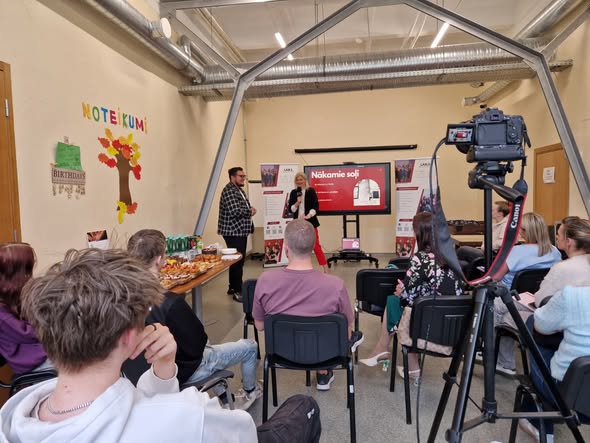
✅️ To present the project’s results to a wider circle of partners and specialists, two information events have also been organised to date. On 18 May 2026, a presentation event entitled ‘Young People’s Communication Experiences and Needs: results of focus group discussions in the context of developing a digital solution for the ‘Path to Understanding’ project’. The event was attended by representatives of the State Probation Service, the Bauska District Social Services, the Bauska District Council, young people and other interested parties. The event featured a presentation of the study’s main findings, young people’s needs and the direction of the app’s development.
🔹️ Meanwhile, on 20 May 2026, at Bauska District Council, the project’s results to date were presented at a seminar for heads of educational institutions in Bauska District, which brought together heads of educational institutions and their deputies from across the municipality. During the seminar, the association “Laiks Jauniešiem” shared the findings derived from focus groups held in educational institutions, the needs and problems identified by young people, and also introduced the features of the “Vai Tu Saproti?” app, its development process and the expected timelines.
🔵 Overall, the work carried out so far within the project shows that young people’s communication difficulties are not isolated incidents, but rather reflect a systemic need for safer, more understandable and more accessible forms of support for young people. The project’s approach combines research, practical workshops, individual mentoring support, collaboration with local authorities and institutions, as well as a digital solution that may become a significant support tool in working with young people in the future.
Social innovation – a social rehabilitation service for young people, ‘The Path to Understanding’ – is being implemented as part of the ESF+ project “Support for New Approaches to the Provision of Community-Based Social Services”, run by the Society Integration Foundation. The project will run until 31 May 2027.
Co-funded by the European Union. , , , ,
Bauska District Council@most active fans@followersYouth International Programmes AgencyYouth AffairsTime for Young PeopleBauska District Social Services“Bauskas Dzīve”